Thursday, April 1, 2010
HE LIKES ME...
Tuesday, March 23, 2010
CUSTOMER CONFRONTATION
- We didn't want to hurt his feelings. Chefs are notoriously touchy about their offerings and we didn't want to cause a scene.
- We felt there was nothing to be gained. In the worst case he'd tell us to go to hell and find someplace else to eat. We knew better than that about Nick. In the best case, he'd offer to take back the food or credit us for the check. We didn't want either of those, as we'd already eaten most of the food and don't want a credit on the bill for food we had eaten. There was really nothing at that point that Nick could do.
Here's one. Go to Los Gatos and Nick's on Main. Order Nani's meatloaf. You'll never have flipped a lip over anything better.
Friday, March 12, 2010
COLD POPPING
"Oh, no. He's not going to talk about that, is he?" you might well ask.
Yes I am. I'm going to talk about calling someone you have never met before and asking them to buy something from you. Call up and blind-side ‘em. Scare hell out of ‘em. It seems only fair. They've been calling you at work for years and asking hard questions to which you don't know the answers. You didn't even know they were going to call. Now it's your turn.
"Why, in the blue-eyed world, would I want to do that?" you say.
There are two primary reasons: 1) You might make an extra buck and 2) for practice.
Today, in your town, there is a guy who just found out he's getting transferred. Yesterday he didn't want to sell his home, but today he's highly motivated.
Today, in your town, there's a woman who just rolled her car into a ball of foil. Yesterday she had no interest in a new car. Today a new car is at the top of her list.
Today, in your town, there's a couple who just found out the rabbit passed on. Today they are in need of an insurance update.
Today, at least in my town, there are a couple of dudes in a faceless tilt-up building who just got funding for the "next big thing." They are hot prospects for your components, test equipment, assembly shop or ad agency.
The human condition changes from minute to minute. People are good buyers for your product/service who didn't exist, as such, yesterday. Some of them will call you, seeking your assistance, but the vast majority will not. They will call your competitors or simply suffer along without you until someone else picks them up.
Only by a well-planned, consistent program of cold canvassing can you hope to reach these people before they mature into full-blown buyers and you have to compete for them in the open market.
Here's the downside to this song: my informal surveys show that only about six in every one hundred calls you make will result in a qualified appointment. That's an awful lot of effort for a comparatively small result, so there must be some other reason to justify your time investment. That reason is practice. Cold calls provide badly needed practice for salespeople, new and experienced. They get and keep you sharp, keep the adrenaline flowing. You can't get ready for a cold call, as you have absolutely no idea what the person on the other end of the line will say. He doesn't know what he's going to say, as he didn't know there was going to be a conversation. A script will do nothing for you, except brand you as another sales pest. You're on your own and living only by your wits. This sharpens you, both on the phone and in person.
The very best thing about practicing with cold calls is that you can't screw anything up. You didn't have anything going in, so you can't lose. With a qualified prospect you make an investment of time, so you can actually lose a deal and that time. With a cold call, you can't lose a thing.
Why don't we make cold calls?
We try to make too many. When I was a young man I went to a sales seminar and the fellow running the program said that, in order to be any good on the phone, you had to make fifty calls a day, until you die. Death, for me, took less than three days.
Fifty a day is way too many. You burn out, you lose enthusiasm, you sound and feel mechanical.
Try one an hour, for openers. Is one an hour enough to do any good for you? Run the numbers. If you make eight calls a day, five days a week, four weeks a month, you will have made a minimum of ONE HUNDRED SIXTY calls at the end of the month. Can you honestly tell me that talking to one hundred sixty new people a month won't make you money and make you a better communicator? I think not.
Another reason we don't make cold calls is we don't know what to say.
Fortunately for you, I know what to say. I went to a seminar and the fellow running the program told me you need a canned pitch. He said you have to have your statement clearly written and say it fast, without breathing, so the prospect won't hang up on you.
I learned my lines flawlessly, but the customers kept forgetting theirs. The faster I talked, the quicker they hung up. Then I noticed a strange phenomenon: A customer never hung up when they were talking. They only hung up when I was talking. The challenge became clear: Keep the customer talking at all costs.
Our customers have been trained not to talk to strangers calling them on the telephone, so they need to be re-trained. We need to hit them with a high-structured question that will jolt them into talking. A question such as:
"Have you sold your home yet?"
"Have you bought your new truck yet?"
"Have leased your office space yet?"
"What microprocessor have you designed in for your new doogers?"
"Have you booked a keynote speaker for your sales conference yet?" (Yes, we all need to cold pop.)
Here's the real beauty to opening a cold call with a high-structured question: You can't get ready for them with a canned pitch, because you have absolutely no idea what they're going to say. You have to play the cards that are dealt you and that makes you sharp.
They might well say, "I have absolutely no intention of selling my home." In that case, the next word you say is critical. It is, "Goodbye." That's right, dump him. You have fulfilled the two primary objectives of a cold call: 1) You reached the person you were trying to reach, and 2) you found out they are not interested in what you have to sell. Dump him and go look for someone else who does want to buy what you're selling. Why waste time and energy on a person who has told you out front that he is not a buyer? Dial another number. Not every person you reach will be disinterested.
Which then brings us a whole ‘nother set of problems. She may say, "We don't plan to sell our home until school is out." What do you say then? I don't know. I'm not making the call. Maybe you'll want to go for an appointment. Maybe you'll try to get some more information. Maybe you'll try to endear yourself (a tough proposition over the phone). All I know is the ball is now in your court and the only way to get it back over the net is to ask a question, and it had better be a good one. Rely on your wits and be comforted by the fact that those wits will get sharper with every call you make.
When I was first in real estate, and making a lot of cold calls to survive, there was one question I was frequently asked that always threw me: "Who told you to call me?" That stopped me. I'd sit there, gasping into the phone, "Errr, ummm, ahhh. . ." and suffering. I wanted to be open, honest and truthful with them, but somehow thought, "I was cold-popping through the book and just hit on you," lacked a certain elan. My friend, Cliff Brown, and I developed a method for dealing with this issue. We called it "Creative Truth."
Cliff was a new insurance salesman and we belonged to a "Brainstormer's Club," which met once a month for breakfast, lead exchange and mutual support. At the end of every meeting, I'd tell Cliff, "Here is your assignment for this month. I want you to talk with 100 people you don't know and ask them if they would like to have their estates updated."
He'd say, "Good, and I want you to talk to 100 people you don't know and ask them if they want to buy or sell real estate. And we'd shake on it to seal the deal.
Then, when someone would say, "Who told you to call me?" I'd say, "Cliff Brown" and it was true because we made it true.
Cold popping will make you creative, quick and resourceful. It actually gets to be fun, once you discover that no matter what the person on the other end of the line may be feeling, he can't get his hands on you. His problem is his problem, unless you choose to accept it. If you don't like the way the conversation is going, if you can't think of what to say, if you're suffering, hang up. Staying on the phone after brain function has shut down will only make you feel worse. Hang up and dial another number. You are in complete control.
You may have noticed that I didn't give my name or company before asking the initial high-structured question. That's because if I get the wrong answer, it doesn't really matter who I am, ‘cause I'm fixing to hang up.
If you are concerned about the apparent rudeness of hanging up on people, bear in mind that it is only rude to hang up if the other party knows you hung up. The key is to hang up in such a fashion that the other party doesn't know you did and the way to do that is hang up while you're talking. As we discussed before, nobody would do that, so the customer is sure you didn't.
After you've hung up, you know you'll think of thirty-three things you could have said, would have said, should have said. That always happens. If you like, call him back and say, "As I was saying when we were disconnected. . ."
Cold popping is absolutely without physical risk, yet many of us still avoid it because we fear rejection.
That's just silly because rejection is a chosen response. He can't reject you without your acceptance of his rejection. His opinion of you is none of your business.
I understood this intellectually, but never actually felt it viscerally until I worked for Bob Potter. It was in Seattle, the year they had the World's Fair and Bob was the General Agent for The Green Shield Life Assurance Company, of Boulder, Colorado. We were selling funeral policies as investments, a sort of fun business. Bob called them "Charter Policies," for reasons still obscure to me.
One morning we were having a sales meeting in his office, which was good, as it was the only office we had. There were about a dozen guys sitting around Bob's big, "T" shaped desk. The president of the company and vice-president, sales, were out from Boulder to pump us all full of smoke and make us go out and sell. The phone rang and Bob answered it, which was good, as he was wonderful on the phone and we always learned something from him. It was also good because we didn't have a secretary. Bob always answered the phone.
Bob had the first telephone amplifier I had ever seen; two big boxes sitting on his desk that made him sound like he was sitting in a barrel. Some guys had Cadillacs as status symbols, but Bob didn't have one. His amplifier was his status symbol and he drove it on all incoming and outgoing calls, voice just booming out for God and everyone else to hear.
"Good morning," he thundered, "This is the Green Shield Life Company." Oh, God, he was good. A thrill to listen to.
A small, timid voice on the other end of the line said, "I'm looking for Mr. Bob Potter, please."
"You got him, partner, what do you need?"
"Well, sir, I'm the assistant manager at the Tradewell store out by your house. We have one of your checks here. It's been returned by the bank."
I felt terrible, mortified, humiliated. Here was my idol being eviscerated by some little clerk in front of his sales staff and bosses. I wanted to yank the phone off his desk to save him.
It didn't even seem to register with Bob. With a great big grin he leaned back in his judge's chair and bellowed, "Now just what the hell did they do that for?"
The little voice seemed even smaller. "Well, sir, your check was marked ‘NSF'."
It was getting worse. This was no mistake. Bob had hung a slow reader on them and he was busted. Bob leaned forward and put his mouth up close to the microphone and dropped it about two octaves. He almost whispered, "Now, my young friend, I want you to remember that I didn't call you, you called me, so you'd better be ready to answer some questions. The first one is, just what does that NSF mean?"
The assistant manager sounded like he was about to cry as he blurted out, "Well, sir, it means not sufficient funds."
Bob leaned back again and laughed loudly. "Oh Bull," he yelled, "Have them run it through another bank, they can't all be out of money." And hung up the phone.
You are in complete control on the phone. Try cold popping for thirty days and it will become a life-long habit. It's not only good for you; it's a blast in the bargain.
Saturday, February 6, 2010
RESPONSIBILITY -- TO OR FOR?

By Hank Trisler
Silverback Sellers, a group in LinkedIn, is currently discussing, rather vehemently, the question of whether incomplete disclosure is the same as deliberate deception. I've wrestled with this for more years than I care to admit, and to me it comes down to the question or whether we are responsible TO, or responsible FOR our customers.
Early in my career as the owner of a real estate company, my secretary asked me if I would help her grandmother sell her home. Would I? Is a bear a Catholic? Of course I'd take great care of her grandmother.
Eva Coutinho was a sterotypical grandmother. She was four feet and a bit of change, had a little cap of hospital-white hair and always smelled a little like cinnamon. If you asked Norman Rockwell to paint you a grandmother, he'd paint Eva Coutinho.
Being a professional Realtor, I carefully measured the home, prepared my market research and determined the house was worth $21,000 (that'll give you some idea of how long ago this was). When I revealed to Mrs. Coutinho the results of my labors and told her we should price at $21,950 (to provide a little "wiggle room"), she replied, "Oh, that's way too much."
This is not a response to which I was accustomed. I said, "I've done my research and I'm confident I can get you this much money for your home. I promised your granddaughter I'd take good care of you, so I want to get you top dollar."
"When my husband and I bought this home, we paid only $8,000 for it. I think $16,000 is more than enough." Eva went on, "Prices are getting so high, I don't know how young people will ever be able to buy a home, like we did."
I pulled on my Ferdinand Fiduciary T-shirt, puffed out my chest and said, "I'm responsible to get you the best price the market will deliver and that's what I'm going to do. Now press hard, the fourth copy's yours."
She knuckled under and at that moment I had ceased being responsible to Mrs. Coutinho, and had assumed responsibility for her. In selling and, I submit, all human relationships, this is the kiss of death.
Within three weeks I had a full price offer contingent upon an FHA loan. She readily accepted it. I was RIGHT. I'd rather be right than effective.
We got a low appraisal. Since I was a professional, I had the comps to get the appraisal raised and it only took about a month. During that time, the buyer had bought a boat, so he no longer qualified for the loan. I was madder than a mashed cat, but there was naught to do but put the house back on the market and find another buyer.
It only took about a month to get a new buyer and another couple of months to get the deal closed and I personally delivered the closing check to Eva Coutinho, much like a retriever bringing a duck to his master. After all, I had gotten her a full $5,000 more than she had wanted.
She seemed a little less that totally enthused. Oh, she was gracious, as that was her nature, but she was just a little less than totally tickled. My spirits were a bit damped, but there is no accounting for taste and I had done my level best as a professional.
Shortly thereafter Mrs. Coutinho left this mortal coil. It seems she had terminal cancer and only wanted to get rid of the house so she could live out her remaining days in peace and comfort. I had consumed nearly six months (more than half) of her remaining life in my efforts to get her more money, which she neither needed nor wanted.
I submit to you that we are responsible to be well-educated, diligent, honest to a fault, and industrious on behalf of our customers. We are not responsible for our customers and for the sometimes dumb (in our opinion) decisions they will sometimes make.
Come on over to Silverback Sellers and let us know how you feel about this.
Thursday, January 28, 2010
RUDENESS BITES
.jpg)
By Hank Trisler
Last week a young friend of mine experienced an extreme act of rudeness on the part of one of his customers, and it really hurt his feelings.
My friend (we'll call him "Vern," for reasons that will soon become obvious) is the sales manager for a local branch of a well-known national hotel chain. He was on time for an appointment he believed to be at 10 a.m. with the Events Manager for a huge Silicon Valley electronics firm. (We'll call them "Gigantus Corporation.") After a suitable wait, he saw a young woman descending the curved staircase into the crowded waiting room. When she got within five steps of the bottom, she called out in a loud voice, "Is there a Vern Jensen here?"
Striding confidently toward her with a big smile and outstretched hand, he said, "That would be me."
"Your appointment was for 9 o'clock and it is now after 10. I will not tolerate tardiness. I want everyone here to know that Gigantus Corporation will no longer do business with Vern Jensen or the Snore More hotel chain he represents." She abruptly turned and ascended the staircase to corporate heaven, from whence she had come.
Crestfallen, Vern went back to his office and rechecked his files. Everything indicated a 10 o'clock appointment, not one for 9. Since he would rather have a good account than be right, he sent the woman a dozen roses and a note of abject apology, assuming all the blame for the misunderstanding and pleading for another appointment. The note was returned, unopened, with a "return to sender" stamp on the front. Vern was baffled by this treatment and called me to see what he should do to regain access to this account, poor misguided soul that he is.
I have no idea what to do to get his foot back in the door. I'm as confounded by rudeness as much as the rest of us. I'm not even sure I'd want to get my foot back in that door. Life is just too short to spend dealing with jerks. My only advice was to keep an eye on the account and contact her successor when she gets blown out. People who behave this way seldom do it to just one person and their evil deeds come back to get them.
That one account isn't really the problem, though. It's the psychic damage that accepting the rudeness of another does to us. I'll bet that in twenty years, long after other, kinder, gentler customers have faded from memory, that act of hostility will return to haunt Vern in the small, dark hours of the morning. I don't know why we forget some of the good times and remember every moment of all the bad, embarrassing times in excruciating detail, but we do.
Responsible to, not responsible for. As professional salespeople, we are responsible to our customers. We are responsible to be honest, punctual, credible and well informed. We must know about our customer's needs and how we can best fill those needs. We are responsible to do the best we can with little bitty tools.
We are not, however, responsible for our customers. We can't help it if sometimes they make bad decisions, in spite of our guidance. We cannot accept responsibility for their actions, or for how they feel about us. Some folks will simply persist in the mistaken belief that we are not the greatest things to come into their lives. They'll have to live with that, as it's just not our responsibility.
The Sympathy Note. I'm sure we can all understand, on an intellectual level, that sometimes people will behave badly and that behavior is their problem, but the intellect isn't where rudeness gets us. Rudeness bites and it gets us in the guts, down deep where it really hurts. I now bring you the Sympathy Note, which can be used to help heal us where we hurt.
Something like eighty-five percent of the people are pretty nice a lot of the time. They won't be rude to us unless they are pressed to rudeness by some external force, often having nothing to do with us. As soon as they have been hostile, the anger diminishes and they often feel a bit badly about how they behaved. The balance of the people are just hostile jerks that constantly employand fully understandrudeness. The Sympathy Note is fairly effective with either type of person and goes something like this:
"Dear___________,
"When I spoke with you today you were rude to me. I know it was nothing I said, as I talked to sixteen people and you were the only one who was hostile.
"I hope that whatever was bothering you is now resolved and that you are feeling better.
"I look forward to speaking with you again soon, with a better result.
"Sincerely,_______"
The nice people who realize they acted badly will very likely apologize when next you speak. The jerks will have a small, grudging admiration for you because you didn't take any crap from them.
"C'mon, does this always work?" Of course not. Nothing always works, but you are writing this after the deal has already blown, so what have you to lose? Besides, you didn't write the note to save the deal, but to save your self-image and allow you to face the next customer with your head held high.
What about Vern? He got his nice note returned. Yeah, and that's the beauty of the high-tech world in which we live. You have e-mail and faxes, which are a lot harder to ignore.
The bottom line: Rudeness bites and should never be used by us, nor should we tolerate its use on us. It is just not good business.
If asked, what would you have told Vern?
Wednesday, January 27, 2010
BADGES OF HONOR
by Hank Trisler
Most meetings have name badges for the attendees, to allow them to enter dark rooms and hear the "secret stuff." Most of us hate to wear them, as they mark us as tourists to the locals and generally look tatty. Badges can serve several useful purposes, however, and will actually be enjoyed by your attendees, if properly deployed.
Badges must have a LARGE first name. This is what most of us look for. At a recent conference, the badge printing was so small that I couldn't make it out, even with my cheaters on. An old fellow staring at people's chests with reading glasses is an upsetting sight, particularly to members of the opposite sex. The person's company and hometown are also nice to have, but not at the expense of a HUGE first name.
Badges should be worn on the right side, so that they are thrust forward when one shakes hands with another. The natural tendency is to wear them on the left, but people will comply, once they've been told the valid reason.
Conferences often unite people from diverse regions or divisions of a company; people who seldom know one another. To stimulate interaction and camaraderie, try writing another person's name on the back of each badge, preferably from another region or division. Any person finding the person whose name is on the back of their badge gets a small prize. Something you were going to give them anyhow. Find the person whose name is on the back of your badge, get their business card and win a prize. How simple. In order to find that person, you might have to introduce yourself to a couple of dozen other people. Think of all the people you'll meet. Badges can be fun and informative, rather than a necessary evil. Your people will never again say, "I don't got to show you no steenking badges."
How do you feel about badges at your meetings?
Sunday, January 3, 2010
IT DON'T COST NUTHIN' TO BE NICE
by Hank Trisler
A good friend just sent this to me and I thought it of sufficient value to re-print it here. Unfortunately, I don't know the name of the original author, but I admire his discernment.
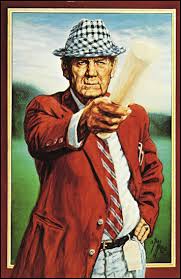
At a Touchdown Club meeting many years before his death, Coach Paul Bear Bryant told the following story:
I had just been named the new head coach at Alabama and was off in my old car down in South Alabama recruiting a prospect who was supposed to have been a pretty good player and I was having trouble finding the place. Getting hungry I spied an old cinder block building with a small sign out front that simply said, Restaurant.
I pull up, go in and every head in the place turns to stare at me. Seems I'm the only white fella in the place. But the food smelled good so I skip a table and go up to a cement bar and sit. A big ole man in a tee shirt and cap comes over and says, What do you need?I told him I needed lunch and what did they have today? He says, You probably won't like it here, today we're having chitlins, collared greens and black eyed peas with cornbread. I'll bet you don't even know what chitlins (small intestines of hogs prepared as food in the deep South) are, do you? I looked him square in the eye and said, I'm from Arkansas , I've probably eaten a mile of them. Sounds like I'm in the right place. They all smiled as he left to serve me up a big plate. When he comes back he says,
You ain't from around here then?
I explain I'm the new football coach up in Tuscaloosa at the University and I'm here to find whatever that boy's name was and he says, yeah I've heard of him, he's supposed to be pretty good. And he gives me directions to the school so I can meet him and his coach.
As I'm paying up to leave, I remember my manners and leave a tip, not too big to be flashy, but a good one and he told me lunch was on him, but I told him for a lunch that good, I felt I should pay.
The big man asked me if I had a photograph or something he could hang up to show I'd been there. I was so new that I didn't have any yet. It really wasn't that big a thing back then to be asked for, but I took a napkin and wrote his name and address on it and told him I'd get him one.
I met the kid I was looking for later that afternoon and I don't remember his name, but do remember I didn't think much of him when I met him. I had wasted a day, or so I thought.
When I got back to Tuscaloosa late that night, I took that napkin from my shirt pocket and put it under my keys so I wouldn't forget it. Back then I was excited that anybody would want a picture of me. The next day we found a picture and I wrote on it, Thanks for the best lunch I've ever had.
Now let's go a whole buncha years down the road. Now we have black players at Alabama and I'm back down in that part of the country scouting an offensive lineman we sure needed. Y'all remember, (and I forget the name, but it's not important to the story), well anyway, he's got two friends going to Auburn and he tells me he's got his heart set on Auburn too, so I leave empty handed and go on see some others while I'm down there.
Two days later, I'm in my office in Tuscaloosa and the phone rings and it's this kid who just turned me down, and he says, Coach, do you still want me at Alabama ? And I said, Yes I sure do. And he says OK, he'll come. And I say, Well son, what changed your mind? And he said, When my grandpa found out that I had a chance to play for you and said no, he pitched a fit and told me I wasn't going nowhere but Alabama, and wasn't playing for nobody but you. He thinks a lot of you and has ever since y'all met. Well, I didn't know his granddad from Adam's housecat so I asked him who his granddaddy was and he said, You probably don't remember him, but you ate in his restaurant your first year at Alabama and you sent him a picture that he's had hung in that place ever since. That picture's his pride and joy and he still tells everybody about the day that Bear Bryant came in and had chitlins with him.
My grandpa said that when you left there, he never expected you to remember him or to send him that picture, but you kept your word to him and to Grandpa, that's everything. He said you could teach me more than football and I had to play for a man like you, so I guess I'm going to.
I was floored. But I learned that the lessons my mama taught me were always right. It don't cost nuthin to be nice. It don't cost nuthin to do the right thing most of the time, and it costs a lot to lose your good name by breakin your word to someone.
When I went back to sign that boy, I looked up his Grandpa and he's still running that place, but it looks a lot better now; and he didn't have chitlins that day, but he had some ribs that woulda made Dreamland proud and I made sure I posed for a lot of pictures; and don't think I didn't leave some new ones for him, too, along with a signed football.
I made it clear to all my assistants to keep this story and these lessons in mind when they're out on the road. If you remember anything else from me, remember this. It really doesn't cost anything to be nice, and the rewards can be unimaginable.
~ Coach Paul Bear Bryant ~
Note: Coach Bryant was in the presence of these few gentlemen for only minutes, and he defined himself for life. Regardless of our profession, we do define ourselves by how we treat others, and how we behave in the presence of others, and most of the time, we have only minutes or seconds to leave a lasting impression. We can be rude, crude, arrogant, cantankerous, or we can be nice. Nice is always a better choice. I like what Stephen Grellet, French/American religious leader (1773-1855) said, I expect to pass through the world but once Any good therefore that I can do, or any kindness I can show to any creature, let me do it now. Let me not defer it, for I shall not pass this way again